


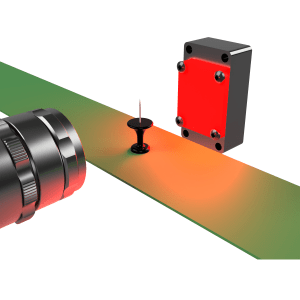
Inspecting very small components with machine vision calls for illumination that brings high uniformity, precise geometry, and stable light intensity in a compact form factor. Standard illuminators are usually oversized for miniature inspection setups. Miniature LED illuminators close this gap, letting engineers build precise backlight and shadow-projection systems for small objects, delicate parts, and tight working distances.
Shadow-based inspection rests on the silhouette contrast between the object and a uniformly lit background. The quality of that contrast depends entirely on the uniformity, intensity, and geometry of the backlight source. Miniature LED illuminators made for backlight applications use opal diffuser glass to form a homogeneous emitting surface—ideal for dimensional measurement, profile inspection, and defect detection on small parts.

Do you want help choosing the product?
Backlight Machine Vision on Small Objects: Technical Requirements
When designing a vision system for small object inspection, the illuminator has to match the object size and the camera field of view. An oversized backlight introduces edge effects and weakens contrast uniformity. Miniature backlights get around this by concentrating the light output on the target zone alone.
Key Parameters for Miniature Backlight Selection
- Active area size: should match or slightly exceed the object footprint
- Uniformity (COV): decisive for consistent silhouette edges
- Diffusion grade: opal glass versus standard glass for shadow projection
- LED wavelength: monochromatic versus white depending on the camera and filter setup
- Working distance: the illuminator has to fit within tight mechanical constraints
- Electrical interface: M12 connector for industrial use or bare wire for OEM mounting
Shadow Projection: How It Works
Shadow projection is one of the most reliable techniques for dimensional control in machine vision. The object sits between the camera and the backlight. The LED illuminator forms a uniform emitting surface behind the part, and the camera captures the resulting silhouette—a sharp-edged shadow—which software algorithms process to extract dimensional data, flag missing features, or verify geometric profiles.
The technique is especially effective for: diameter and length measurement of turned parts, connector pin presence verification, burr detection on injection-moulded components, gap measurement in assembled subassemblies, and profile inspection of medical devices.
DL3M Series: High-Intensity Miniature LED Illuminators
The RODER DL3M Series is built for applications that need compact, high-intensity illumination in a miniature housing. The series supports both direct illumination and, when fitted with opal diffuser glass, backlight configurations for shadow-projection inspection. DL3M modules carry high-flux LEDs in multiple wavelengths including white, red, blue, green, and infrared.
DL3M illuminators can serve as standalone point backlights or combine in small arrays for slightly larger inspection areas. Their compact form factor and M12 electrical interface make them easy to drop into robotic cells, desktop inspection stations, and OEM machine vision modules.
DL3M Technical Highlights
- Compact housing, starting from 25×25 mm active area
- High-flux LEDs for maximum intensity in small formats
- Available with standard glass or opal glass for diffuse backlight
- Wavelength options: white, red 625 nm, blue 470 nm, NIR 850 nm
- Continuous and strobe operating modes
- M12 connector or flying leads for OEM integration
- Aluminium housing with passive thermal management
Selecting the Right Illuminator for Miniature Backlight Systems
For applications with a very small field of view, engineers can also reach for compact BL-series backlight panels. The RODER BL2 and BL3 series offer uniform LED backlights in small and medium formats, delivering high uniformity and optimised diffuser optics for dimensional and profile inspection.
When the inspection involves small reflective or curved components viewed from the front, low-angle ring illuminators such as the DC2 series provide grazing-incidence light to lift surface relief and edge contrast—a technique that complements backlight for thorough small-part inspection.
Comparison: Illumination Techniques for Small Object Inspection
| Technique | Best For | RODER Series |
|---|---|---|
| Backlight diffuse | Dimensional measurement, profile, silhouette | DL3M opal, BL2, BL3 |
| Low-angle ring light | Surface relief, edge detection, engraving | DC2 Series |
| Direct front light | Surface colour and texture inspection | DL3M standard glass |
Integration Notes for Engineers
- Mounting: use the threaded holes on the illuminator housing for rigid fixturing
- Power supply: connect to a RODER LED driver or compatible constant-current controller
- Strobe mode: sync the illuminator to the camera trigger for exposure-matched pulsing
- Ambient light rejection: pair with narrow-band filters on the camera lens in bright factory environments
- Thermal management: ensure enough airflow for long continuous-duty cycles
Products and Technologies
RODER Illuminator Families for Small Object Inspection

Miniature LED illuminators — compact housing from 25×25 mm, opal glass option for diffuse backlight, wavelengths from UV to NIR

Compact backlight LED illuminators — active areas from 50×50 mm, high uniformity diffuser, continuous and strobe modes

High-intensity backlight LED illuminators — high-brightness LEDs, optimised diffuser optics, formats from 100×100 mm to 500×500 mm

Low-angle ring LED illuminators — grazing incidence illumination for surface relief, scratch detection, and edge contrast on small components
Frequently Asked Questions
Miniature LED illuminators serve backlight inspection, shadow projection, and dimensional measurement of very small components. They also fit compact vision systems where standard-size illuminators could not be integrated mechanically.
A miniature backlight illuminator has a smaller active emitting area matched to compact or macro optics. It delivers uniform illumination in a far smaller housing, allowing integration in tight inspection stations and OEM modules.
Yes. Fitted with opal diffuser glass, DL3M illuminators produce a uniformly diffused light surface suited to shadow-projection dimensional inspection.
Red (625 nm) is the pick for sharp silhouette edges. NIR (850 nm) works for translucent materials. White light suits general-purpose inspection.
The active area should match or slightly exceed the object footprint. For very small objects, the DL3M series or BL2 compact panels are the recommended starting point.
Contacts & Information
Contact for general information : info@roder.it
Systems and Sensor Integration Partner : www.roder.it
RODER Artificial Vision Division : www.visiotronix.com
RODER Instruments Division : www.innovacheck.com
More information about VISIOTRONIX : about us
The information on this website is provided for informational purposes only. Although it has been prepared with the utmost care, it does not constitute a contractual offer or a binding commitment to supply. It may contain transcription, translation, or typographical errors. For precise and up-to-date information, please contact our company directly.
Please note: Some images on this website have been intentionally generated using Artificial Intelligence (AI). This is due to the fact that, for many applications and projects, it is not possible to disclose photographs of the actual installation or system due to confidentiality agreements, contractual clauses, and Non-Disclosure Agreements (NDAs).


